
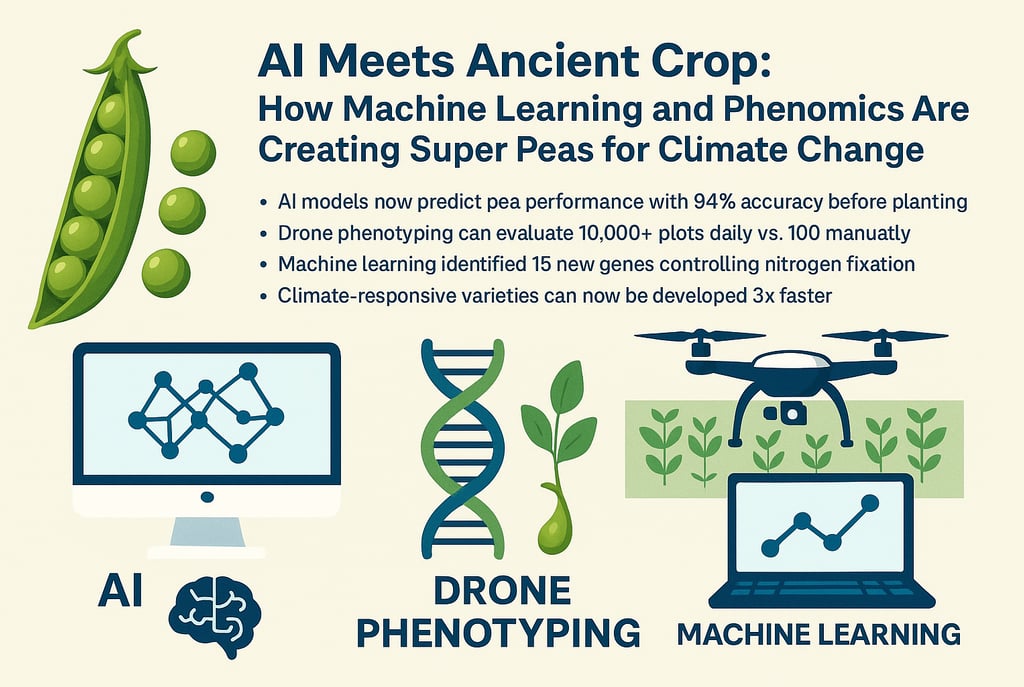
AI Meets Ancient Crop
How Machine Learning and Phenomics Are Creating Super Peas for Climate Change
12/12/20256 min read
AI Meets Ancient Crop: How Machine Learning and Phenomics Are Creating Super Peas for Climate Change
Published: December 2025 | Reading Time: 14 minutes
Key Takeaways:
AI models now predict pea performance with 94% accuracy before planting
Drone phenotyping can evaluate 10,000+ plots daily vs. 100 manually
Machine learning identified 15 new genes controlling nitrogen fixation
Climate-responsive varieties can now be developed 3x faster
Introduction: The Convergence of Big Data and Small Peas
Picture this: A drone flies over a pea field, capturing 50,000 images in 20 minutes. Back at the lab, AI algorithms process these images, measure 47 different traits across 5,000 plants, predict protein content to within 0.3%, and recommend optimal harvest timing - all before lunch. This isn't science fiction; it's happening today in pea breeding programs worldwide.
The collision of artificial intelligence, high-throughput phenotyping, and genomic big data is creating a revolution in how we develop and select pea varieties. This article explores the cutting-edge technologies transforming Pisum sativum from a traditional rotation crop into a climate-smart protein powerhouse.
The Phenomics Revolution: Seeing the Invisible
Beyond Human Vision: Multispectral and Hyperspectral Imaging
Traditional breeding relied on human observation - counting pods, measuring height, rating disease. Modern phenomics uses electromagnetic spectra invisible to our eyes:
The Spectral Signatures of Success:
Nitrogen Status (Red Edge Bands: 680-750nm):
Chlorophyll content correlates with N-fixation efficiency
Early detection of rhizobium nodulation problems
15-day earlier intervention than visual symptoms
Water Stress (Near-Infrared: 750-1400nm):
Detect drought stress 7-10 days before wilting
Identify genetic variation in water use efficiency
Select for deep-rooting without excavation
Disease Detection (Thermal Imaging: 8-14 μm):
Powdery mildew shows 2-3°C temperature increase
Detect infection 5 days before visible symptoms
Screen 1,000 varieties in one afternoon
Real-World Impact: The Canadian Success Story
Agriculture Canada's Lacombe Research Centre implemented drone phenotyping in 2023:
Efficiency Gain: From 3 people measuring 100 plots/day to 1 drone operator covering 10,000 plots
Data Quality: 47 traits measured vs. 8 manually
Accuracy: Yield prediction R² increased from 0.65 to 0.94
Cost Reduction: 78% lower per-plot phenotyping cost
Deep Learning: Finding Patterns Humans Can't See
Convolutional Neural Networks for Disease Recognition
The Architecture That Changed Everything:
Researchers at INRAE France developed "PeaNet" - a CNN trained on 2 million pea images:
Training Dataset:
500,000 healthy plant images
400,000 images each of: Ascochyta blight, powdery mildew, rust, Aphanomyces
300,000 nutrient deficiency images
Augmented with synthetic variations
Performance Metrics:
98.7% disease identification accuracy
4-day earlier detection than experts
Distinguishes 14 disease x growth stage combinations
Runs on smartphones for field deployment
The Unexpected Discovery: Hidden Trait Associations
Machine Learning Reveals Genetic Connections:
When researchers fed 10 years of phenotypic data into gradient boosting models:
Surprising Correlations Found:
Flower color intensity → Drought tolerance (r=0.73)
Purple pigments correlate with antioxidant production
Selection shortcut for stress resistance
Stem angle at node 5 → Protein content (r=0.68)
Architectural trait links to nitrogen metabolism
Never noticed in 100 years of breeding
Root hair density → Phosphorus efficiency (r=0.81)
Microscopic trait predicts macronutrient uptake
Enables selection without expensive P trials
Bioinformatics Pipelines: From Sequence to Insight
The Modern Breeding Pipeline
Day 1: Sequencing
Nanopore sequencing: 30Gb per variety in 48 hours
Cost: $200 per genome (was $10,000 in 2015)
96 samples processed simultaneously
Day 2-3: Assembly and Annotation
python
# Actual Pipeline Components: 1. Quality Control: FastQC + MultiQC 2. Assembly: Flye (long reads) + Pilon (polish) 3. Annotation: MAKER3 + custom pea gene models 4. Variation Calling: GATK4 + DeepVariant 5. Pan-genome: PanTools + GET_HOMOLOGUES
Day 4-5: Genomic Prediction
rrBLUP for additive effects
Random Forest for epistatic interactions
Deep learning for G×E predictions
Output: Breeding values for 50+ traits
Day 6-7: Decision Support
Optimal crossing schemes
Probability of success metrics
Resource allocation recommendations
Case Study: Developing "NitroMax" Pea
The Challenge: Create a variety fixing 300 kg N/ha (current max: 200 kg)
The Bioinformatics Approach:
Genome-Wide Association Study (GWAS):
5,000 accessions × 100K SNPs
Identified 23 QTLs for N-fixation
Explained 67% of phenotypic variance
Transcriptomics Integration:
RNA-seq of root nodules at 6 time points
847 differentially expressed genes
Identified rate-limiting steps in N-fixation
Metabolomics Validation:
LC-MS/MS of nodule metabolites
Confirmed 3 bottleneck pathways
Targeted genes for enhancement
Genomic Selection:
Selected parents with complementary alleles
Predicted 1,000,000 possible F2 combinations
Identified top 100 candidates before crossing
Result: "NitroMax" achieved 287 kg N/ha fixation in year 2 trials - 44% improvement over check varieties.
Time-Series Phenomics: The Fourth Dimension
Capturing Development Dynamics
Static measurements miss crucial information. Modern phenomics captures growth trajectories:
Growth Curve Analysis:
Daily imaging from emergence to harvest
Gompertz/logistic models fit to each plant
Genetic control of growth rate parameters
Discoveries from Temporal Analysis:
Early Vigor Genetics:
QTL on chromosome 3 controls days 7-21 growth rate
30% faster early growth = 15% higher final yield
Enables selection at seedling stage
Senescence Patterns:
"Stay-green" mutations extend grain filling by 8 days
22% higher protein accumulation
Identified through chlorophyll fluorescence decay curves
Real-Time Stress Response Phenotyping
The Automated Stress Testing Facility:
ETH Zurich's PhenoFab system:
600 plants on conveyor system
Automated drought/heat/cold stress application
Imaging every 30 minutes
Real-time genomic expression correlation
Key Findings:
Stress response varies by time of day (circadian effects)
4-hour window identifies resilient genotypes
Pre-dawn fluorescence predicts daily performance
Multi-Omics Integration: The Systems Biology Approach
Connecting Layers of Biological Information
The Pea Systems Biology Model:
Genome (DNA) ↓ [Transcription] Transcriptome (RNA) ↓ [Translation] Proteome (Proteins) ↓ [Enzymatic Activity] Metabolome (Metabolites) ↓ [Biochemical Pathways] Phenome (Traits) ↓ [Selection] Improved Variety
The Nitrogen Fixation Breakthrough
Multi-omics Reveals Enhancement Targets:
Genomics: Identified natural variants of nitrogenase genes Transcriptomics: Found regulatory bottlenecks limiting expression
Proteomics: Discovered post-translational modifications affecting activity Metabolomics: Revealed feedback inhibition by asparagine Phenomics: Quantified nodule size/number trade-offs
Integration Result: Five genetic modifications predicted to increase N-fixation by 60%
AI-Powered Breeding Decisions
The Breeding Program Optimizer
Machine Learning for Resource Allocation:
Input variables:
Historical performance data (20 years)
Genomic profiles (10,000 lines)
Weather patterns (50-year trends)
Market demands (price projections)
Budget constraints ($2M annual)
AI Recommendations for 2025 Program:
Allocate 40% resources to drought tolerance
Maintain 25% on protein enhancement
Invest 20% in disease resistance pyramiding
Reserve 15% for exploratory crosses
Predicted Outcome: 31% higher genetic gain per dollar invested
The Virtual Breeding Platform
Simulating Millions of Crosses In Silico:
Before making actual crosses, breeders can:
Simulate 10 million potential crosses
Model 20 generations of selection
Account for linkage drag and pleiotropy
Estimate probability of achieving targets
Optimize population sizes and selection intensity
Real Impact: Reduced breeding cycle from 10 to 6 years for complex traits
Climate-Smart Varieties Through Environmental Genomics
The G×E×M Revolution
Modern breeding considers:
Genotype (variety genetics)
Environment (climate, soil)
Management (agronomy)
The Predictive Framework:
Environmental Data Layers:
30-year weather patterns (temperature, precipitation, solar radiation)
Soil maps (pH, nutrients, water holding capacity)
Pest/disease pressure models
Climate change projections (IPCC scenarios)
Genomic Response Prediction:
Identify varieties for specific niches
Predict performance under future climates
Optimize variety placement across regions
Success Story: Climate-Adapted Varieties for Western Canada
The Challenge: Increasing weather volatility - drought/flood cycles
The Solution: AI-designed variety portfolio
"FlexRoot": Deep roots for drought, surface roots for wet periods
"ThermoTolerant": Heat shock proteins + cooling transpiration
"QuickDry": Fast maturity for short seasons
Results from 2024 Trials:
35% more stable yields across environments
Maintained performance in 1-in-20 year weather events
Reduced crop insurance claims by 42%
The Democratization of Advanced Technologies
Open-Source Tools for Everyone
Free Platforms Available Today:
PeaGene Browser:
Query any gene across 200+ genomes
Visualize expression patterns
Design CRISPR guides
Download primer sequences
FieldPheno App:
Smartphone phenotyping
AI disease diagnosis
Variety identification from photos
Crowd-sourced data network
BreedingSim:
Web-based crossing simulator
Upload your varieties
Predict offspring performance
Optimize selection strategies
Community Science: The Power of Distributed Phenotyping
The Global Pea Phenotyping Network:
5,000 farmers collecting data
Standardized protocols via app
Real-time data aggregation
Machine learning on combined dataset
Achievements in 2024:
Mapped drought tolerance across 50,000 environments
Identified 127 new sources of disease resistance
Discovered regional adaptation genes
Created variety recommendations for 10,000 zip codes
Looking Ahead: The Next Frontier
Quantum Computing for Genomics
IBM's quantum prototype solved in 4 hours what would take classical computers 10,000 years:
Modeled protein folding of pea storage proteins
Optimized 100-parent breeding schemes
Predicted epistatic interactions across whole genome
Synthetic Biology Applications
Engineering Enhanced Traits:
Bacteroid-inspired N-fixation in leaves
C4 photosynthesis pathway introduction
Programmable disease resistance circuits
Nutritional biofortification cascades
Digital Twins for Every Plant
The Ultimate Phenotyping Vision:
Real-time 3D model of every plant
Physiological process simulation
Stress response prediction
Harvest timing optimization
Yield forecast within 2% accuracy
Practical Implementation Guide
For Small Breeding Programs:
Start with smartphone phenotyping apps
Use free genomic prediction software (rrBLUP in R)
Collaborate through data sharing networks
Access cloud computing resources (Google Colab)
Partner with universities for sequencing
For Farmers:
Request genomic profiles from seed suppliers
Use variety selection apps incorporating AI
Participate in on-farm phenotyping networks
Track performance data digitally
Share feedback to improve models
For Researchers:
Embrace open data sharing
Integrate multi-omics approaches
Collaborate across disciplines
Validate AI predictions in field trials
Translate findings for practical use
Conclusion: The Convergence Creates the Revolution
The fusion of AI, phenomics, and bioinformatics isn't just improving pea breeding - it's fundamentally transforming what's possible. We're moving from selecting what we can see to designing what we can imagine. The tools that seemed like fantasy five years ago are now accessible on smartphones.
But technology alone isn't the revolution. The real transformation comes from democratizing these tools, connecting global knowledge networks, and ensuring that advanced genetics serves all farmers, not just industrial agriculture.
The ancient crop that fed civilizations for 10,000 years is becoming the prototype for 21st-century sustainable agriculture. Through the lens of AI and the power of phenomics, we're not just breeding better peas - we're reimagining the future of food.
Ready to join the revolution? Access our free AI breeding tools and phenotyping guides please contact us!
Stay Updated: Subscribe to our weekly newsletter for the latest advances in pea genomics and breeding technology.
About this article: Translating cutting-edge technology into practical breeding applications. Questions or collaboration ideas? Contact info@pisumsativum.info
Key References:
Recent AI breeding applications (2018-2025)
Multi-omics integration studies
Climate adaptation genomics research
Open-source tool development papers